
Privacy in a residential landscape is rarely about building an impenetrable botanical wall around an entire lot. More often, it is about solving a specific spatial conflict: screening an adjacent second-story lanai, obscuring pool equipment, softening a blank stucco wall, or blocking the view of a neighbor’s driveway while seated on your patio.
Homeowners frequently shop for privacy plants by asking for the fastest-growing hedge on the nursery floor. That approach consistently backfires in Southwest Florida. Rapid growth does not stop once the plant hits the top of your fence line. Without evaluating exact eye levels, available bed depth, and realistic maintenance commitments, fast growers quickly swallow walkways, shade out understory plantings, and demand constant trimming.
Designing a functional screen requires matching mature plant habit to your physical space before putting a single shovel in the ground.
Identify the Specific Sightline You Need to Block
Living screens succeed when targeted at concrete viewing angles rather than abstract property boundaries. Effective backyard planning starts by mapping out precise sightlines rather than trying to wall off the entire perimeter. A hedge planted to block the street while standing at the kitchen window requires a completely different position and height profile than one designed to provide privacy on a pool deck lounger.
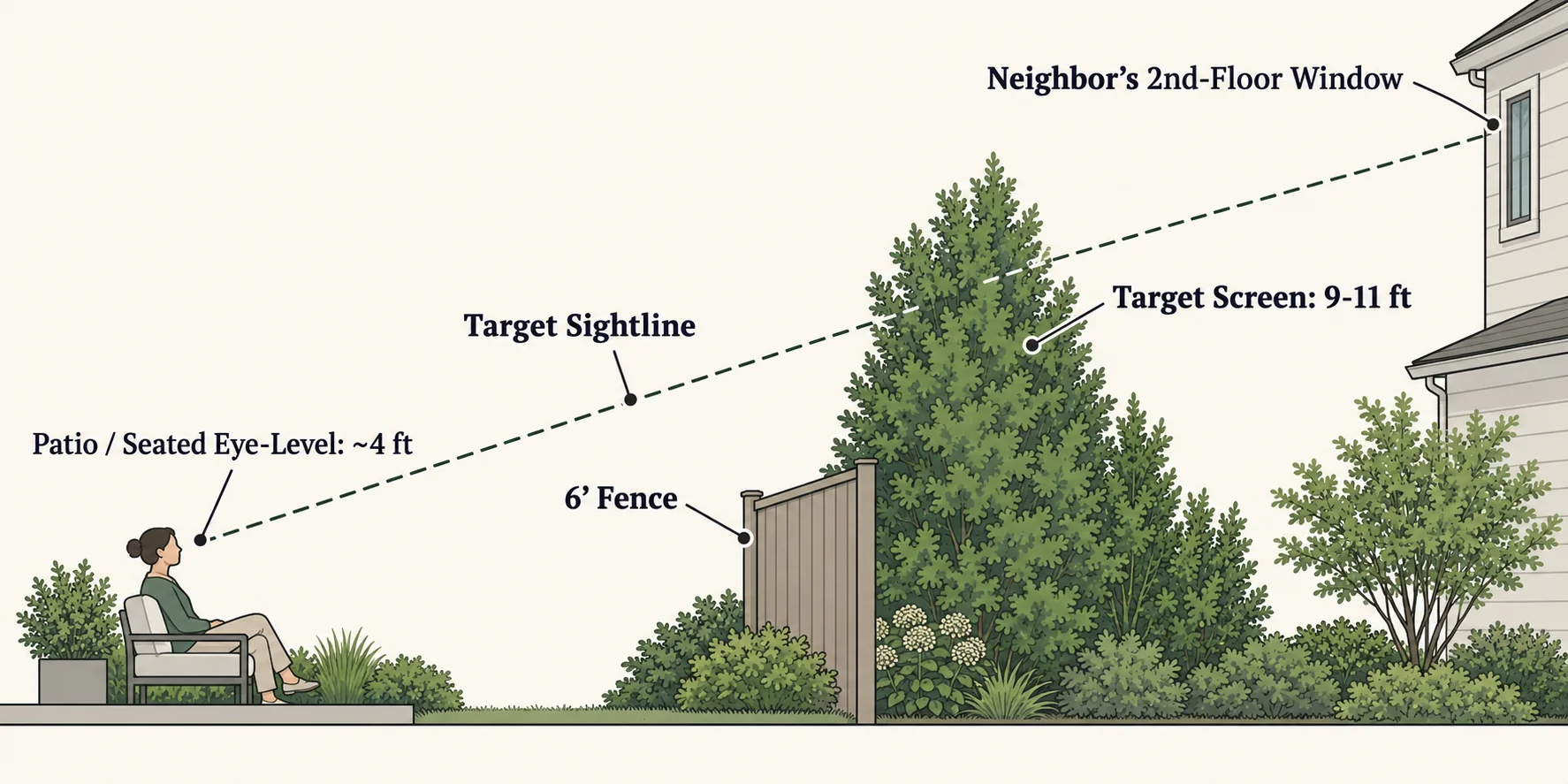
- Target Sightline: Neighbor's 2nd-Floor Window → Target Screen: 9-11 ft → Patio / Seated Eye-Level: ~4 ft
- 6’ Fence
To define what you actually need, work through three field observations:
- Locate the station points: Sit where you spend your leisure time—in your lanai chairs, by the pool edge, or at an outdoor dining table. Note the exact angle of the intrusion. Stand at critical indoor windows and look out. You will often discover that a strategically placed cluster of shrubs 8 feet away solves a privacy issue far better than a 60-foot line of hedges planted against the property line.
- Determine screening density: Decide whether the target requires a 100% year-round visual block (such as an outdoor shower or pool pump) or a filtered, softening buffer (such as breaking up a view of a neighbor's roofline).
- Protect valuable outward views: In Southwest Florida, screening one nuisance can accidentally erase a prized view of a lake, preserve edge, or mature golf course canopy. Identify the sightlines you want to keep before choosing plant material that might overgrow them.
Measure the Bed Width Before Picking a Plant
Vertical height is only half the equation; usable bed depth dictates what species will survive and thrive long-term. A common mistake is buying a plant rated for 12 feet of height and planting it in a 24-inch planting strip bordered by a concrete foundation and a paver deck.
A plant's root system and natural branching habit need lateral room. Forcing an naturally broad plant into an ultra-narrow bed creates continuous structural stress and turns property upkeep into a perpetual chore.
Before choosing plant varieties, confirm these spatial constraints:
- Usable Bed Depth: Measure the distance between hard barriers (such as your foundation, pool deck, or fence). Check the selected species and cultivar’s mature spread, intended pruning approach, and access needs against that measurement before choosing a screen.
- Two-Sided Maintenance Access: If you place a hedge against a boundary fence, you still need to prune both sides or leave room for the plant to mature without pushing through the pickets into your neighbor’s yard. Ensure you can physically reach the rear of the bed.
- Overhead Clearance: Look up. Roof soffits, gutters, overhead utility lines, and the overhang of existing shade trees will dictate the ultimate functional ceiling of your screen.
- Root Zone Restrictions: Consider adjacent footers, irrigation supply lines, and drainage swales. Plants shoved tight against concrete foundations encounter restricted moisture profiles and high soil pH caused by masonry leaching.
Compare Screen Candidates by Growth Habit and Site Realities
Selecting the right plant involves balancing light, available bed width, and the architectural habit of the species. Florida native plants offer outstanding drought resilience and regional hardiness, but each behaves differently depending on environmental exposure.
| Plant Candidate | Light Exposure | Natural Habit | Bed Fit to Confirm | Screen Density |
|---|---|---|---|---|
| Simpson's Stopper (Myrcianthes fragrans) | Full Sun to Partial Shade | Upright, multi-stem large shrub/small tree | Cultivar, spread, access | Dense in sun; open in shade |
| Inland Cocoplum ('Red Tip'/'Green Tip') | Full Sun to Partial Sun | Broad, upright dense shrub | Mature spread and access | High; easily maintained |
| Green Buttonwood (Conocarpus erectus) | Full Sun | Spreading, vigorous large tree/shrub | Pruned form and access | Very dense if pruned regularly |
Simpson’s Stopper (Myrcianthes fragrans)
Simpson’s stopper is an adaptable native that serves as either a formal hedge or an informal screen. Its performance hinges on solar exposure: sunlight affects the density of Simpson’s stopper (opens in a new tab), driving tight, branching growth in full sun and a looser, more open branching structure in partial shade.
If your goal is a tight visual block between homes, plant it in open, sunny locations. Left unpruned, it slowly develops into a multi-stemmed small tree reaching 15 to 20 feet, displaying handsome mottled bark. If space is tight, look for the 'Compacta' cultivar, which maintains smaller leaves and a more naturally restricted footprint.
Keep in mind that frequent shearing to hold a razor-flat geometric edge cuts off the emerging flower buds, eliminating the small, fragrant white flowers and seasonal red berries that support native pollinators and songbirds.
Cocoplum (Chrysobalanus icaco)
Cocoplum is a classic Florida hedge plant, but you must know which form you are purchasing. Ecotype selection matters here because cocoplum forms differ in height and growth habit (opens in a new tab).
The coastal ecotype, sold as 'Horizontal', is naturally low-growing and spreading and usually stays below six feet; whether it screens an eye-level view depends on the target height. For perimeter screening, use the upright inland selections, commonly sold as 'Red Tip' or 'Green Tip'.
Inland cocoplum produces glossy, rounded foliage and responds well to regular light trimming. It can easily establish a dense hedge between 6 and 12 feet tall, provided it has adequate root space and full to moderate sun.
Green Buttonwood (Conocarpus erectus)
Valued for its durability in difficult exposures, green buttonwood handles high heat, poor soils, and wind. While site-specific salt-tolerance guidance should dictate plant placement near open bays or Gulf winds, green buttonwood is generally well suited to coastal microclimates.
However, homeowners frequently underestimate its scale. Without ongoing intervention, green buttonwood can become a substantial tree (opens in a new tab) reaching heights well over 30 feet with a massive canopy spread.
You can maintain it as an opaque, clipped privacy hedge at 8 to 12 feet, but doing so requires consistent mechanical pruning. If you skip pruning cycles for a season or two, the lower branches will thicken into heavy wood, making it difficult to pull the plant back into a formal shape without leaving bare, leafless stubs.
Choose Between a Clipped Hedge and an Informal Screen
The maintenance profile of your landscape is largely decided by whether you choose a clipped, formal hedge or an informal, multi-species buffer.
- Formal Clipped Hedge: Tight footprint, frequent shearing
- Informal Multi-Species Screen: Tree, Shrub, Shrub, Clumping; Wider bed, seasonal pruning, layered
Formal Clipped Hedges
A sheared hedge provides a sharp, architectural boundary on a compact footprint. It can fit where property lines run close to driveways or pool cages, provided the selected plant can be maintained within the available bed depth.
- Tradeoffs: High maintenance. A formal hedge may need frequent trimming during active growth to maintain crisp lines; frequency depends on the plant and desired finish. Formal shearing strips away flowering tips, produces flat visual planes, and increases vulnerability to scale or fungal issues if air circulation within the interior canopy drops.
Informal Mixed Screens
An informal screen relies on the natural mature form of the plants. Instead of planting a single row of the same shrub, you stagger two or three compatible species with varying heights, textures, and foliage colors.
- Tradeoffs: Potentially lower maintenance, but requires bed width suited to the plants’ mature forms. Hand pruning removes rogue water sprouts or shapes growth away from hardscapes, with frequency depending on growth and clearance needs. This approach preserves natural flowers, fruit, and nesting habitat while creating deep, layered visual privacy that feels like an intentional garden rather than a green wall.
Set Realistic Expectations for Establishment
A healthy living screen requires patience. Property owners frequently want immediate, opaque privacy on day one, which leads to installation mistakes that undermine the plants over time.
Purchasing mature, field-grown material in large container sizes can block critical views immediately, but larger specimens take longer to recover from transplant shock and establish deep root systems. Smaller container-grown plants may establish more readily, but the tradeoff between initial screening and establishment depends on species, root condition, and care.
Avoid the temptation to solve privacy concerns by planting shrubs closer together than their root systems can handle:
- Do not jam plants together: Packing shrubs tightly against one another creates quick ground-level privacy, but the crowded canopies will soon shade out their own lower branches. As the plants mature and fight for sunlight, the bottom leaves drop, leaving you with bare, woody stems right at eye level—defeating the entire purpose of the screen.
- Plan for establishment irrigation: Even drought-tolerant natives need establishment watering, with the amount and duration based on species, soil, weather, and rooting progress rather than a single calendar period.
- Account for seasonal growth rates: Growth slows dramatically during the cool, dry winter months (December through March). Most of your visual screening bulk will develop during the warm, wet months of summer.
Build a Planting Brief for Your Yard
Before consulting with a professional on your project, assemble a concise summary of your property’s conditions. Bringing specific measurements and site observations ensures you design a screen that fits both your space and your daily lifestyle.
Use this checklist to build your screening brief:
- Target Sightline: Exactly what are you screening (e.g., neighbor's patio, parked boat, street traffic), and from where are you viewing it (seated on the lanai, standing at the kitchen sink)?
- Screening Target Height: The specific vertical height needed to interrupt that sightline (usually 6, 8, 10, or 15 feet).
- Bed Dimensions: Usable length and depth of the planting bed, noting distances to property lines, sidewalks, fences, and building foundations.
- Sun Exposure: Hours of direct sun the planting area receives year-round (full sun, shifting partial shade, or dense shade beneath existing canopies).
- Maintenance Preference: A willingness to prune frequently to maintain a formal geometric hedge, or a preference for an informal border with more room for natural growth and pruning as needed.
- HOA and Municipal Constraints: Local restrictions on maximum hedge heights along property boundaries, sight-triangle rules near road intersections, and drainage easements.
Careful site analysis bridges the gap between seeing a plant you like and making it perform reliably on your property. Integrating your measurements into a complete planting design ensures the screen serves its purpose without outgrowing its bounds.
When you move from planning to execution, partnering with specialists in professional landscape installation helps navigate proper soil prep, root spacing, and irrigation setup.
When you are ready to evaluate your property’s sightlines and select living screens tailored to your space, talk with Signature.