
DETAILED SERVICE
French Drains for Recurring Yard Drainage Problems
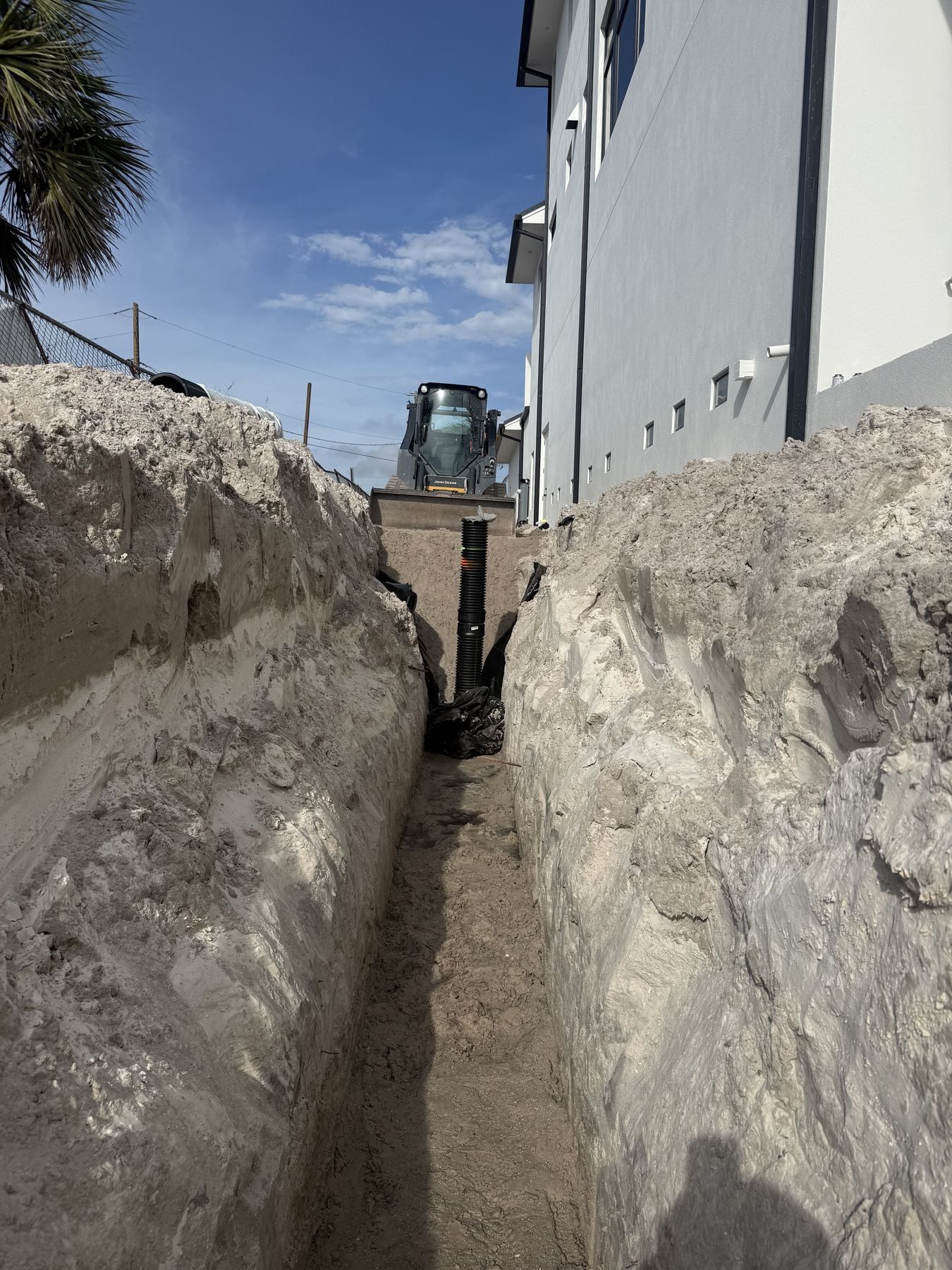
How Water Moves and Collects Across the Yard
Heavy downpours across Southwest Florida quickly reveal low spots, saturated turf, and standing water. Homeowners often ask for a French drain when water pools along a foundation, floods garden beds, or leaves a side yard soggy for days. However, jumping straight to a specific drainage technique before mapping how water moves across the property can lead to ineffective installations.
A practical solution starts with observation. We track where water originates, how quickly it accumulates, where it gathers, and how long it remains after the rain stops. Seeing the actual path of the water establishes whether subsurface collection is the right remedy or if another method is required.
When a French Drain Is the Right Drainage Solution
A French drain is a subsurface interception method designed to collect groundwater and slow-percolating surface water, carrying it away through a gravel-lined trench. It is an effective tool, but it is not a universal fix for every drainage challenge.
Determining if a French drain fits your property requires evaluating several site factors:
- Available slope to move water naturally by gravity
- A viable, legal discharge point that will not create problems downstream
- Soil permeability and the volume of water entering the zone
- Nearby underground utilities, large tree root systems, and property lines
Evaluating comprehensive Drainage solutions during an on-site assessment helps identify an approach that addresses the underlying issue without simply moving water to another problem area.
French Drain Placement, Routing, and Outlet Planning
A successful drainage project relies on careful routing. Trenching without a clear plan can compromise existing utilities or fail to move water effectively.
Where the Water Comes From and Collects
Water issues rarely originate solely where the puddle forms. Runoff often starts at concentrated roof downspouts, higher-elevation neighboring lots, or wide lawn expanses that lack adequate pitch. We identify these collection points to determine where water enters the ground and where an underground trench will intercept it most effectively.
Where Collected Water Can Be Directed
Every subsurface drain requires a dependable outlet. Before digging, we identify a logical, gravity-fed exit point or designated collection zone. The route must channel water safely away from foundations and structural elements without discharging across property boundaries or creating new pooling zones.
Utilities, Hardscaping, and Areas the Trench Must Avoid
Drainage lines frequently cross active landscape zones. A well-planned route identifies irrigation lines, private electrical conduits, root systems, and hardscape footings in advance. Planning also accounts for site restoration, establishing how turf, planting beds, and ground covers will be repaired once excavation is complete.
Installing Drainage Before Hardscaping and Landscaping
Installing new outdoor features over unmanaged drainage issues leads to settled foundations, eroded joints, and costly repairs. Subsurface water accumulation can compromise the base materials supporting Paver patios and cause uneven settling along Paver walkways.
Addressing underground water management before building Hardscaping and retaining walls protects both your structural investments and plant health. You can review examples of drainage planning alongside finished landscapes in our Drainage-related project examples.
Problems a French Drain Is Not Designed to Solve
French drains excel at gathering dispersed, slow-draining subsurface water along a specific line. However, they are not designed for every scenario:
- High-volume roof runoff: Concentrated water from downspouts often overwhelms gravel trenches and is better handled by solid-pipe conductor lines or direct catch basins.
- Surface sheet flow: Broad, fast-moving surface water across an open yard is often best redirected using surface re-grading or shallow swales.
- Deep standing basins: Large low areas may need dedicated collection points rather than an indirect subsurface filter.
Matching the right drainage mechanism to the volume and speed of the water helps avoid system overload and supports reliable performance over time.
French Drain Installation FAQs
01QuestionWhat should I document before asking whether a French drain is appropriate?
Response
Take photos and short videos during and immediately following a heavy storm. Document where water originates, where it collects, how deep it gets, and the number of hours or days it takes to dry out.
02QuestionHow is a French-drain assessment different from a general yard-drainage assessment?
Response
A general drainage assessment evaluates overall property grading, roof discharge, and broad runoff patterns. A French-drain assessment focuses specifically on whether subsurface water interception along a defined trench route will solve the problem and whether suitable slope and discharge points exist.
03QuestionWhen might a water problem require a different approach than a French drain?
Response
High-velocity surface runoff, massive volumes from roof downspouts, and widespread flat lawn areas often require surface swales, direct catch basins, or smooth-wall solid piping rather than a subsurface percolation trench.
04QuestionWhat needs to be checked before a drainage trench is planned near utilities, irrigation, a patio, or a walkway?
Response
Public utility locations must be marked, and private lines—including irrigation pipes, landscape lighting wire, and pool equipment lines—must be identified. The route must also maintain safe clearance from hardscape footings to protect structural stability.
05QuestionHow are discharge, property-line, HOA, and permitting questions handled?
Response
Discharge points must comply with local municipal codes, HOA rules, and easement restrictions. Water cannot be directed onto neighboring private properties or into unapproved zones, making outlet selection an integral part of the planning process.
06QuestionWhat restoration work should be discussed after drainage excavation?
Response
Excavation temporarily disrupts grass, soil, and mulch beds. The project scope should detail how trenches will be backfilled, compacted, and re-sodded or re-mulched to return the yard to a clean, finished condition.
SERVICE DETAIL
Schedule a Yard Drainage Assessment
Every landscape features a distinct mix of soil conditions, grade elevations, and water volume. Rather than guessing which method will resolve your standing water, let our team evaluate your property’s specific water patterns and design a dependable solution.